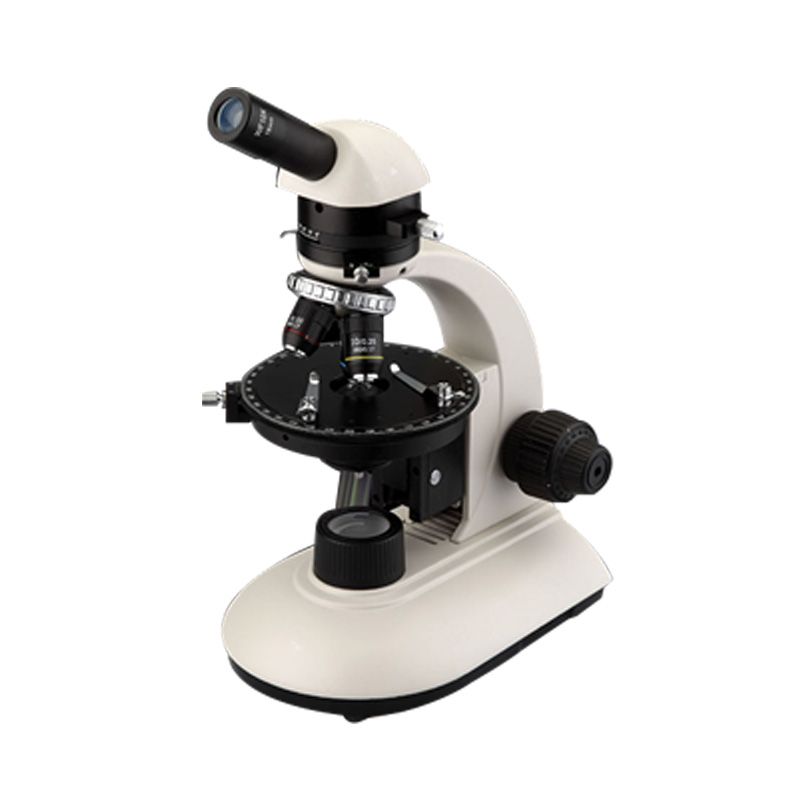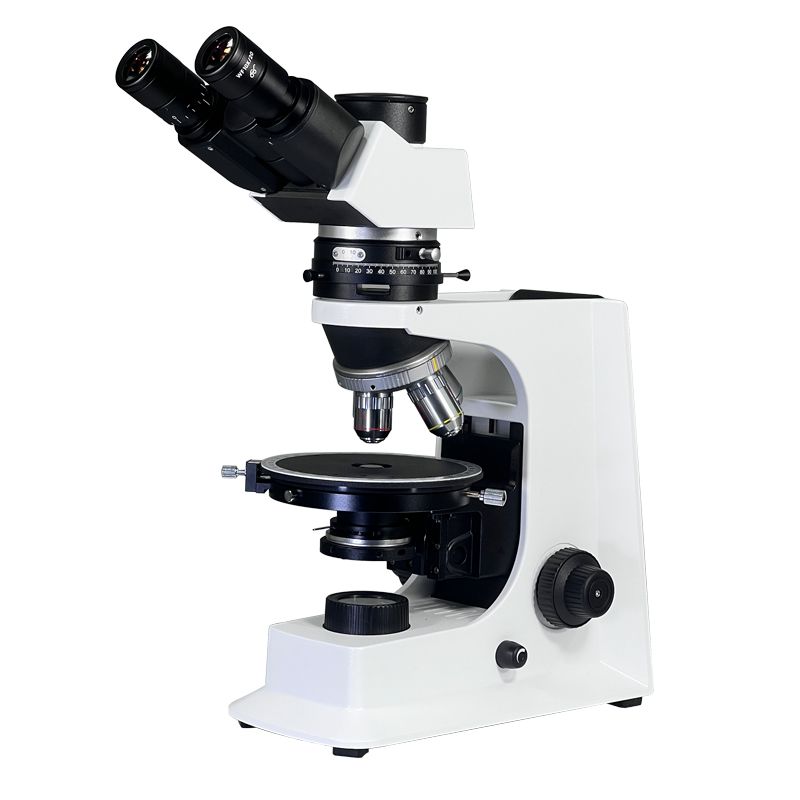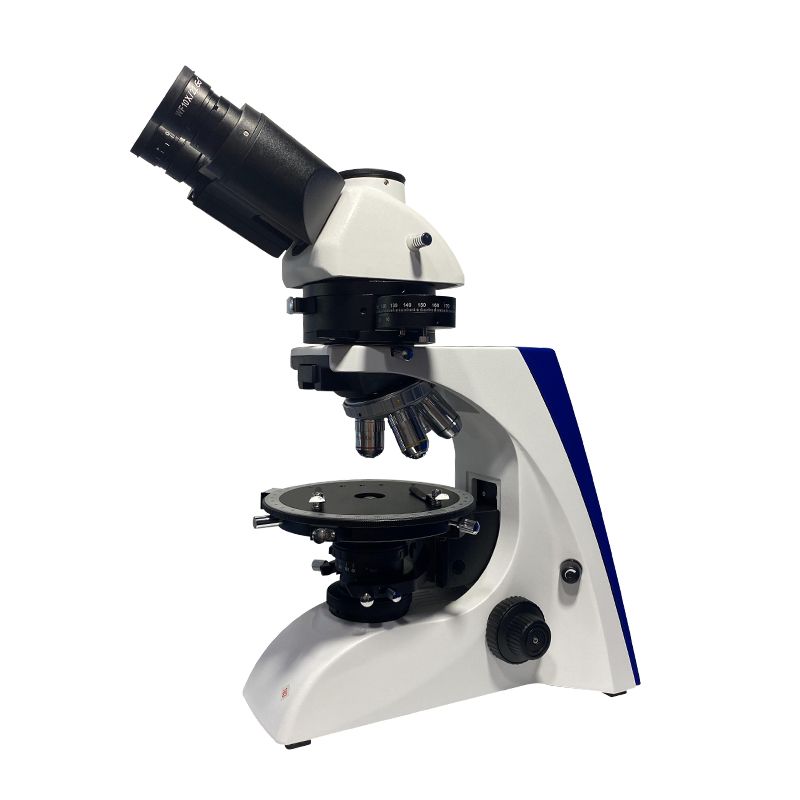
Ever stared at your microscope screen, confused, thinking, “Why can’t I see the crystal structure?” or “Is this microscope even right for my sample?” You’re not alone. Choosing between a Polarizing Microscope and a Standard Microscope boils down to one simple question: What do you need to “see” in your sample?
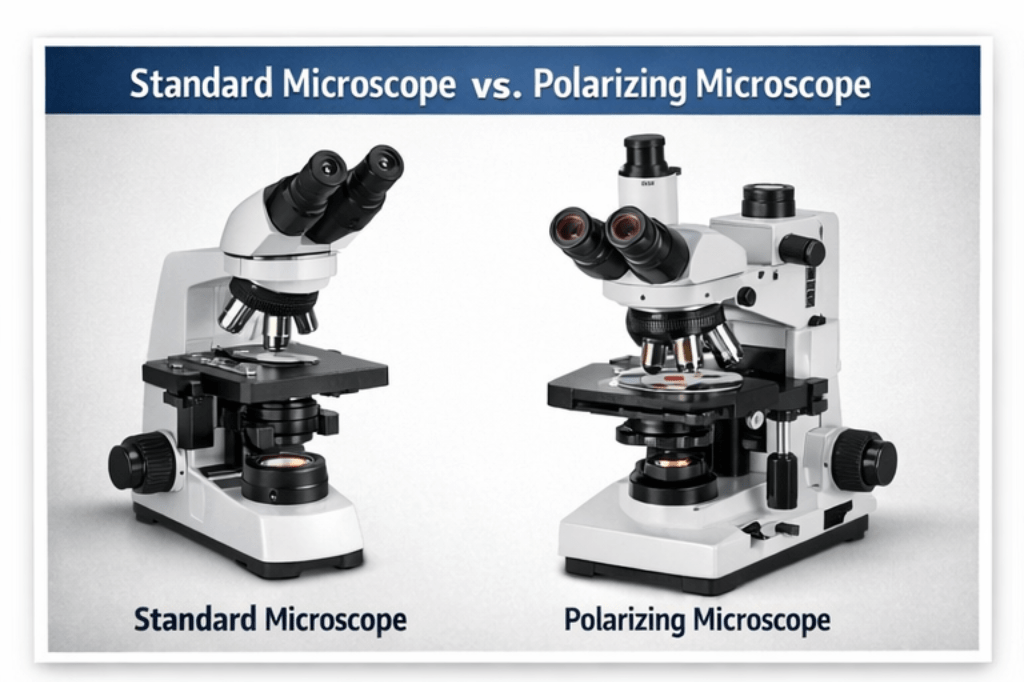
Here’s the golden rule you need to remember: Your sample dictates the tool. It’s not about which microscope is “better,” but which one is right for what you need to see.
- You need to see shape, structure, or surface details (e.g., cell morphology, insect wing patterns): You likely need a Standard Microscope.
- You need to see internal crystal structure, stress patterns, or optical properties (e.g., mineral types, polymer orientation) : You likely need a Polarizing Microscope.
They are not upgrades of each other. They are fundamentally different tools for different jobs. Picking the wrong one is like using a hammer to screw in a bolt—frustrating, ineffective, and a waste of resources.
“Am I Using the Wrong Microscope?”: Polarizing Microscope vs. Standard Microscope — What’s Actually Different?
Often, when a microscope seems “not to work,” it’s just the wrong type for the task. Let’s cut through the jargon.
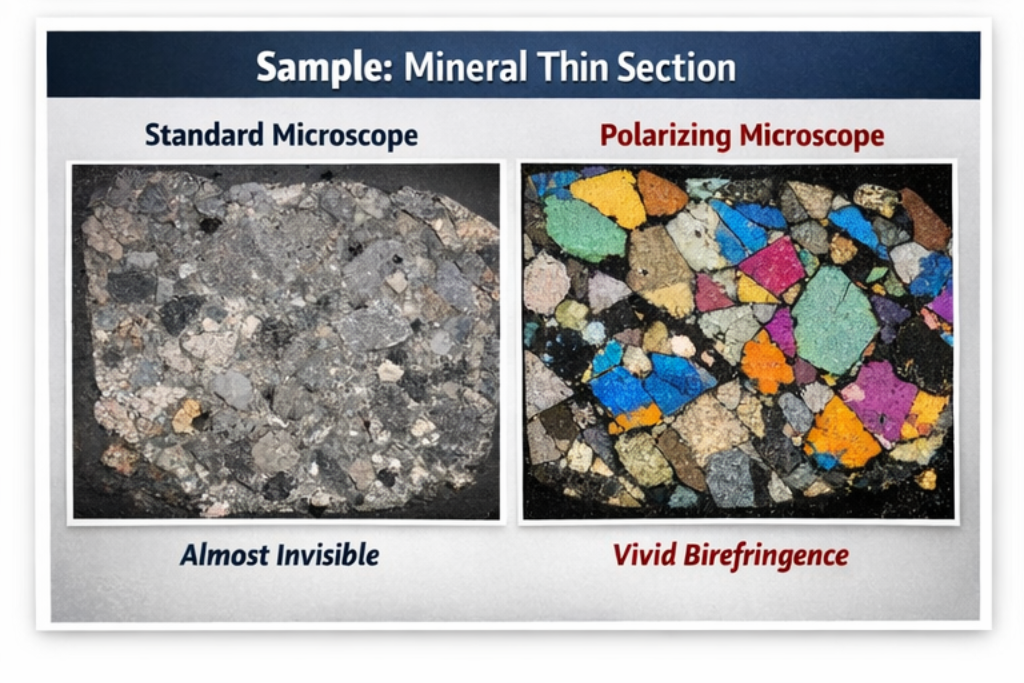
| Aspect | Standard Microscope | Polarizing Microscope | What This Means For You |
| Core Principle | Geometric Magnification. A powerful magnifying glass. It shows you true morphology and color in detail. | Physical Optical Interference. Uses polarized light to interact with the sample, revealing inherent material properties invisible to normal light, like crystal orientation. | The key question: Do you need “what it looks like” or “what it’s made of”? Study cell division? Standard. Study crystal growth? Polarizing. |
| Primary Use | Observing morphology and surface structure. Think: cell shape, bacteria, insect parts, circuit board traces. | Observing optical anisotropy (how a material interacts with light differently depending on direction). Think: colorful mineral bands, stress lines in plastic, fiber alignment. | “Looks” vs. “Properties.” Choose accordingly. |
| Key Components | Light source, condenser, objectives, eyepieces. Often modular for adding cameras or contrast techniques. | Must include: Polarizer, Analyzer (two polarizing filters), a 360° rotatable stage. Often has a Bertrand Lens for conoscopic viewing. | The specialized parts make polarizing microscopes more complex and typically more expensive. Don’t pay for features you’ll never use. |
| Ideal Samples | Biological specimens (cells, tissue sections), everyday objects (insects, pollen, textiles), electronics. Great for education, healthcare, general R&D. | Crystalline & birefringent materials: Mineral/rock thin sections, polymers (plastics, fibers), liquid crystals, pharmaceutical powders. Essential for geology, materials science, polymers. | Look at your sample first! This column is your fastest filter. |
| Image Result | Shows the true color of the sample (Brightfield imaging). Contrast relies on stain or sample color. | Produces vibrant interference colors and contrast based on birefringence. These colors are a “code” to material properties, not the sample’s real color. No stain needed. | Need true color documentation? Go Standard. Need colors to interpret material traits? Go Polarizing. |
| Ease of Use | Relatively straightforward. Learn to focus and adjust light, and you’re basically good to go. | Has a learning curve. Requires learning to calibrate “center” and achieve “cross-polarization” for correct images. Needs some initial training. | If multiple untrained users will share the scope, a polarizing model might slow down workflow. |
| Upgrade Path | Highly flexible. A good standard microscope body can often be upgraded later with phase contrast, fluorescence, DIC, etc. | Very specialized. You cannot turn a standard microscope into a true polarizing scope by just “adding filters.” The core mechanics (like the rotating stage) are missing. | If your future needs might diversify, investing in a good, modular standard microscope body is a more adaptable choice. |
Polarizing Microscope vs. Standard Microscope: They “See” Different Things
The biggest difference? Think of them as detectives with different specialties.
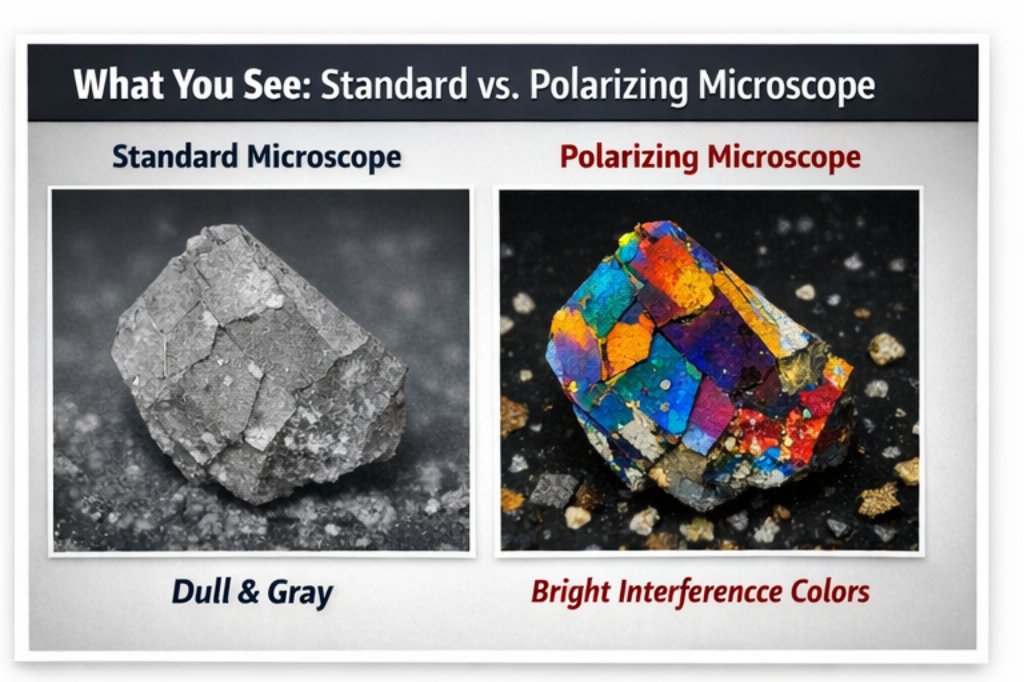
- The Standard Microscope is the Morphology Detective. It answers: “What does this look like?” – Size, shape, surface texture, color.
- The Polarizing Microscope is the Materials Detective. It answers: “What is this made of / how is it structured internally?” – Crystal type, molecular alignment, internal stress.
Your question determines which detective you call.
| Your Main Sample | The Question You Need Answered | Recommended Type | Why It’s The Right Choice |
| Rock Thin Sections, Minerals | “Is this quartz or calcite?” “What’s the crystal grain size and shape?” | Polarizing Microscope | Different minerals produce unique interference colors under polarized light—their diagnostic “fingerprint.” A standard scope makes most minerals look similarly transparent. |
| Plastics, Polymer Films | “Is the molecular orientation uniform from the molding process?” “Is there residual stress inside the part?” | Polarizing Microscope | Visualizes invisible stress distribution and crystalline areas as colored patterns. A core tool for quality control and materials R&D. |
| Biological Tissues, Cells | “Is the cell nucleus morphology normal?” “Where is the target protein located in this stained section?” | Standard Biological Microscope | The perfect tool for showing true stained colors and morphological detail. The workhorse of life sciences and medical diagnostics. |
| Metal Surfaces, Chips | “Are there any surface scratches?” “What is the grain structure of this metal?” | Standard Metallurgical Microscope | Uses incident (reflected) light from above for opaque surfaces. A polarizing microscope is ineffective here. |
| Liquid Crystals, Drug Powder | “At what temperature does this liquid crystal change phase?” “Does this drug have different polymorphs (crystal forms)?” | Polarizing Microscope | Exquisitely sensitive to changes in birefringence. Phase transitions or polymorph conversions become visually obvious. |
Which “ Can’t See ” Problems Only a Polarizing Microscope Fixes?
Some issues aren’t user error—they’re a tool mismatch.
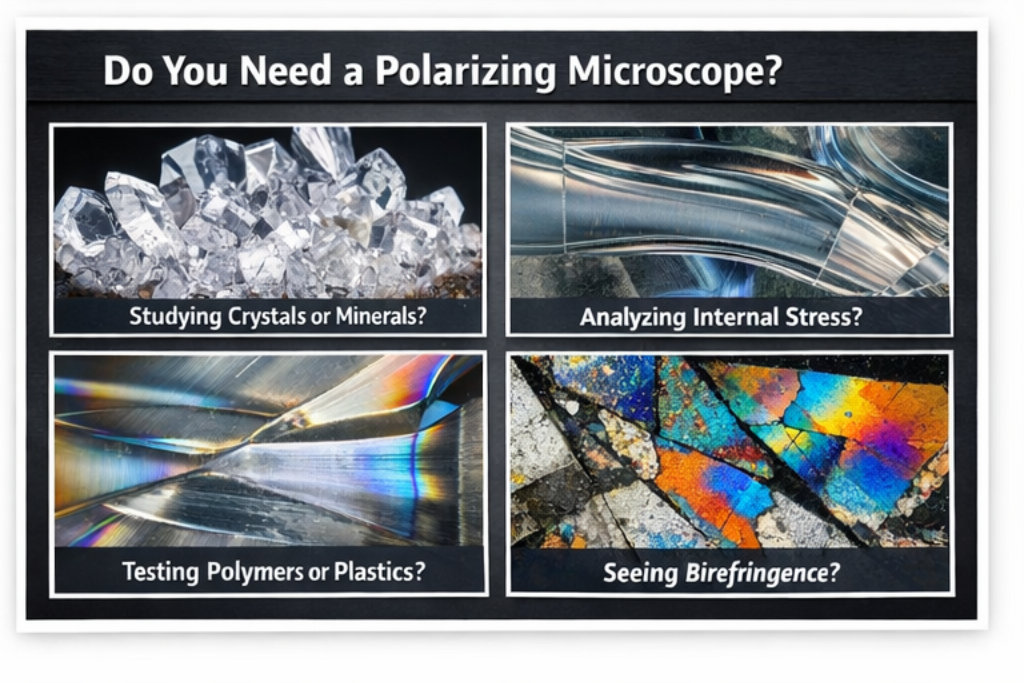
If you’re seeing these problems, a standard microscope may never fix them:
- Crystal samples that look almost invisible
- No contrast, even with perfect focus
- Internal stress patterns that don’t show up
- Transparent materials that all look the same
- “I need to check this clear plastic part for internal stress, but I can’t see anything with the naked eye or our standard microscope.
- “My mineral/crystal samples just look clear and featureless under our regular scope!”
- “I need to quickly differentiate between two similar-looking fibers (e.g., nylon vs. polyester), but chemical staining is too slow/destructive.”
Why?
Because standard microscopes rely on brightness and staining.
Polarizing microscopes rely on how light interacts with structure.
That’s why they’re essential in geology, materials science, and polymer analysis.
When You Definitely Don’t Need a Polarizing Microscope
Let’s be honest—polarizing microscopes cost more and require more setup.
You probably don’t need one if:
- You mainly observe biological samples
- Your work focuses on surface inspection
- You rely on staining and color contrast
- Multiple beginners will use the microscope
- Speed and simplicity matter more than deep material analysis
In these cases, a good standard microscope will be faster, cheaper, and more practical.
Polarizing Microscope vs. Standard Microscope: A Quick Buying Decision Flow
Before you buy, ask yourself:
1. Is my sample crystalline, polymer-based, or optically anisotropic?
2. Do I need to understand internal structure or material behavior?
3. Am I willing to invest time in learning polarization alignment?
- Mostly yes → Polarizing Microscope
- Mostly no → Standard Microscope
That’s it. No overthinking needed.
Final Thoughts
Choosing between a Polarizing and Standard Microscope isn’t about “which is better”—it’s about which matches your sample and needs. To recap: Standard for shape/color, Polarizing for crystal/stress/material properties.
There is no “universal” microscope, only the “right” one for your specific task. A little clarity upfront saves significant money and future headaches.
Need more tailored advice?
Drop a comment below with your specific situation! For example: “I mainly analyze polymer film crystallization, budget around $3K…” I’m happy to offer more pointed guidance.