
If you’re shopping for a microscope, you’ve probably hit a wall of technical jargon: dual-light paths, numerical aperture, total magnification…
But let’s be real—you don’t want a physics lesson. You want to know one thing: “Which of these will help me see what I need to see without wasting my money?”
The truth is, these two tools are built for totally different worlds. Choosing the wrong one isn’t just a minor mistake; it can make your project literally impossible to see.
The “One-Sentence” Secret to Deciding
If you’re in a hurry, here is the only rule you need to follow:
- Stereo Microscopes are for looking at the outside of solid things in 3D (like a coin or a bee).
- Compound Microscopes are for looking through tiny, thin things at massive magnification (like blood cells or bacteria).
Stereo vs. Compound Microscopes: Which One Should You Actually Buy?
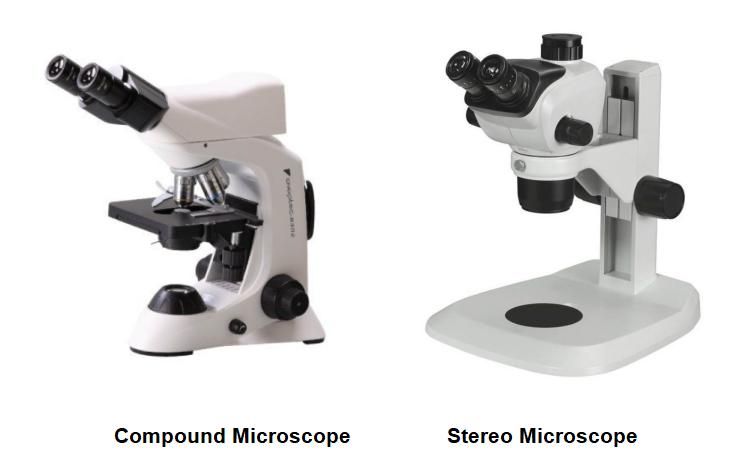
Instead of listing specs, let’s look at the questions that actually matter when you’re reaching for your credit card.
| Buying Question | Stereo Microscope | Compound Microscope |
| What are you looking at? | Solid objects you can hold | Thin slices or liquids on slides |
| How does it look? | 3D with depth and texture | 2D flat, high-detail internal view |
| Do I need to prep samples? | No. Just put it under the lens | Yes. Usually requires slides & stains |
| Can I use tools under it? | Yes. Plenty of room for hands | No. The lens is almost touching the slide |
| Magnification Power | Low to Mid (10x – 80x) | High (40x – 1000x+) |
| Who is it for? | Hobbyists, Jewelers, Engineers | Students, Medics, Lab Techs |
Stereo vs. Compound Microscopes: “What Exactly Is On Your Desk?”
The biggest mistake buyers make is choosing a microscope based on “how much it zooms.” Magnification is useless if it’s the wrong kind.
You need a Stereo Microscope if your samples are:
- Electronics: Soldering circuit boards or inspecting PCB traces.
- Nature Finds: Looking at whole insects, rocks, or flowers.
- Jewelry: Checking hallmarks, gemstone clarity, or watch gears.
- Manufacturing: Quality control on small mechanical parts
- The Vibe: It’s like having a super-powered pair of reading glasses that give you amazing 3D depth.
You need a Compound Microscope if your samples are:
- Biology: Studying plant cells, animal tissue, or pond water “critters.”
- Medical: Analyzing blood smears or urine samples.
- Microbiology: Hunting for bacteria or yeast.
- Education: Standard high school or college biology lab work.
- The Vibe: It’s like a portal into a hidden world that is invisible to the naked eye.
Don’t Fall for the “High Magnification” Trap
In the world of microscopes, more zoom does not equal more “better.” If you buy a 1000x Compound Microscope to look at your coin collection, all you will see is a dark, blurry mess. Why? A compound microscope needs light to pass through the object. Unless your coins are made of glass, you won’t see a thing.
Conversely, if you buy a Stereo Microscope to see bacteria, you’ll be disappointed. Even at its highest zoom, a bacterium will still be invisible.
Pro Tip: If your sample doesn’t require a glass slide to hold it, you almost certainly want a Stereo Microscope.
Stereo vs. Compound Microscopes: Which One Wins?
- Pick the Stereo Microscope if you want to explore the world around you, fix things, or enjoy a hobby. It’s “plug and play,” beginner-friendly, and offers the most “wow” factor for everyday objects.
- Pick the Compound Microscope if you are a student, a researcher, or a hobbyist specifically interested in the “micro” world of cells and germs.