Resolution is all about making the microscope fit your sample, not about buying the priciest gear on the shelf. Once you focus on your sample size, whether it’s moving, and if you need color detail, you’ll nail the perfect resolution—no guesswork, and no wasted cash.
- Hobbyists/Students (Basic Bio): 1–5 μm spatial resolution, low temporal/spectral resolution.
- Labs/Clinical Work (Cells, Blood): 100–200 nm spatial resolution, moderate temporal/spectral resolution.
- Materials Science/QC (Semiconductors, Metals): 10–50 nm spatial resolution, high spectral resolution.
- Advanced Research (Organelles, Nanoparticles): 10–50 nm spatial resolution, high temporal/spectral resolution.
First: What Is Microscope Resolution and Why Resolution Isn’t Just “Zooming In”
Think of it like your smartphone camera. A low-res photo looks “crunchy” or blurry because the sensor can’t pick up tiny details—like the ridges on a fingerprint. A high-res photo makes those details pop. Magnification (making things bigger) and resolution (making things clear) are totally different. You can blow up a blurry photo 1,000 times, but it’s still just a big, blurry mess. Resolution is about clarity, not size.
There are three main types of resolution to keep on your radar:
- Industrial Inspection & Macro Biology (The “Big” Small Stuff) If you’re checking out insects, circuit boards, or large plant structures, a stereo microscope is your best friend. You’re looking at resolution in the micrometer (μm) range. What matters here is depth of field and color accuracy, not nanometer precision.
- The Cellular Level (The Bread and Butter) This is where most lab work happens. You’re looking at bacteria, blood cells, or tissue cross-sections. You’ll likely need a Compound Light Microscope. Traditional light physics caps your resolution at about 200 nm. Keep an eye on the NA value (Numerical Aperture) on your objective lens. If you want to see bacteria clearly, you need an oil immersion lens with at least a 1.25 NA.
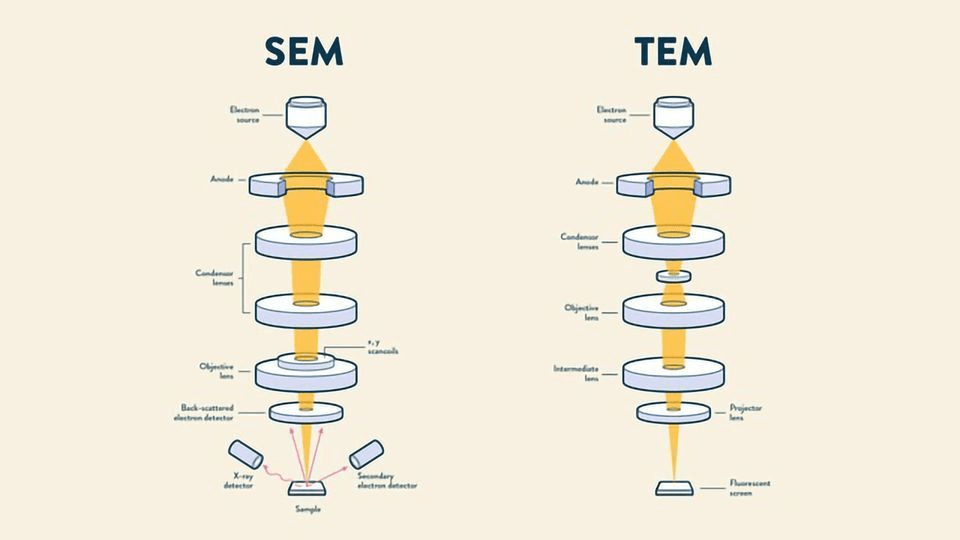
- The Nanoscale (The Deep Dive) When you need to see viruses, individual molecules, or the crystal lattice of a metal, you’ve left the world of visible light behind. You’re now looking at Electron Microscopy (SEM/TEM) or Super-Resolution techniques. Your resolution needs will sit between 1 nm and 10 nm.
So,What resolution do I need for microscopy?
Industrial Inspection & Macro Biology (The “Big” Small Stuff):
If you’re observing insects, circuit boards, or large plant structures, you’ll need a stereo microscope. Resolution is measured in micrometers (μm), and what really matters here is depth of field and color accuracy — not nanometer-level precision.
The Cellular Level (The Bread and Butter):
This is where most lab work happens. You’re looking at bacteria, blood cells, or tissue cross-sections. You’ll likely need a compound light microscope. Traditional light physics caps resolution at about 0.2 µm. Pay close attention to the NA (Numerical Aperture) value on the objective lens. If you’re imaging bacteria, you’ll need at least an NA 1.25 oil immersion objective.
The Nanoscale (The Deep Dive):
When you need to see viruses, individual molecules, or the crystal lattice of a metal, you’ve moved beyond the limits of light. You’re now in the world of Electron Microscopy (SEM/TEM) or super-resolution techniques. The required resolution here ranges from 1 nm to 10 nm.
| User Type / Scenario | What You’re Looking At | Typical Size | Spatial Resolution Needed | Time Resolution Needed | Spectral Resolution Needed | Suitable Technique | Why This Level Is Practical |
| Hobbyist / Student (Basic Biology) | Plant cells, insect organs | 10–100 µm | 1–5 µm | 1–10 fps (static samples) | Not critical (50+ nm if basic staining) | Stereo or standard optical microscope | Plant cells are large. This resolution clearly shows cell walls, nuclei, chloroplasts. No need for extreme detail or speed. |
| High School / Undergraduate Lab | Animal cells, bacteria | 1–5 µm | 200–500 nm | 10–30 fps (slow-moving cells) | 30–50 nm (if fluorescence used) | Compound light microscope | Bacteria are 1–5 µm. This resolution reveals shape (rod, cocci) and flagella. Basic spectral separation helps distinguish dyes. |
| Clinical Laboratory | Blood smears, tissue samples | 5–20 µm cells | 100–200 nm | 5–15 fps (mostly static) | 20–40 nm (for cell/protein staining) | High-NA optical microscope | Needed to distinguish RBCs, WBCs, and abnormal cells. Subtle cellular morphology matters. |
| University Biology Research | Bacteria, organelles | 500 nm–5 µm | 200 nm–1 µm | 10–30 fps | 20–50 nm | High-NA optical / Confocal | Enables visualization of mitochondria and intracellular structures. |
| Advanced Virus Research | Viruses, proteins | 20–300 nm | <50 nm | 10–30 fps | 10–20 nm | TEM / Super-resolution | Viruses fall below optical limits. Nanoscale resolution required. |
| Materials Science | Nanomaterials, metal grains, defects | 1–100 nm | 0.1–100 nm | 1–5 fps (static) | 10–30 nm | SEM / TEM | Nanoscale defects and structural details require high spatial precision. |
| Semiconductor Inspection | Microchips, circuit features | 5–500 nm | 1–50 nm | 10–50 fps (high throughput) | 5–15 nm | SEM | Detecting sub-10 nm fabrication defects requires nanoscale imaging. |
| Advanced Cellular Research | Organelles, nanoparticles | 50–1000 nm | 10–50 nm | 30–100+ fps | 5–20 nm | Confocal / SEM / Super-resolution | High resolution reveals organelle structure; high speed tracks intracellular motion. |
| Industrial Quality Control | Microelectronics, microfluidics | 5–100 nm | 5–50 nm | 10–50 fps | 5–15 nm | SEM | Needed for rapid defect detection and material purity analysis. |
| Atomic-Level Research | Crystal lattice, atomic structures | <1 nm | Sub-nm | Low–Moderate | Not primary factor | TEM / AFM | Required for atomic-scale structural analysis. |
Key Factors That Determine the Resolution You Actually Need
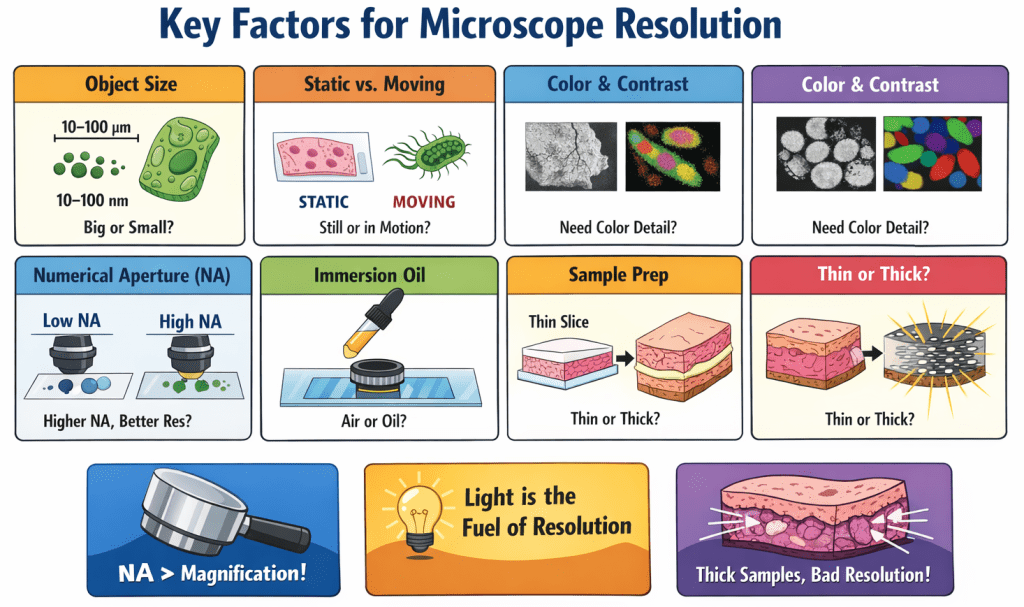
1. How big is the object you’re observing?
This is the most important factor.
If your sample is large (for example, plant cells = 10–100 μm), you don’t need ultra-high resolution at the nanometer level.
If your sample is very small (for example, nanoparticles = 10–100 nm), then you’ll need resolution below 100 nm.
A simple rule of thumb:
Your resolution should be at least 1/10 of the smallest detail you want to see.
2. Is your sample static or moving?
Static samples (like fixed tissue or metal components) only require low time resolution, meaning slower image capture is fine.
Moving samples (like swimming bacteria or dividing cells) require high time resolution — higher frame rates — to avoid motion blur.
If you’re only observing static samples, there’s no need to pay for high time resolution. That’s just wasted money.
3. Do you need color or contrast detail?
If you’re only observing basic shapes (like insect wings), spectral resolution doesn’t really matter.
If you’re using fluorescence, staining, or doing material analysis, then you’ll need spectral resolution to distinguish different colors or wavelengths.
The more colors you use, the higher the spectral resolution you’ll need.
4. Numerical Aperture (NA)
This is the most important number on your objective lens.
A higher NA means better resolution.
If you have to choose between a 100× lens with a low NA and a 60× lens with a high NA, choose the 60× every time.
5. The Medium Matters
Air has its limits. That’s why we use immersion oil.
It bridges the gap between the glass and the slide, allowing more light to enter the objective lens.
More light captured means better resolution.
6. Sample Prep Is King
If your tissue slice is too thick, light scatters — and your resolution goes out the window.
Thin samples = sharp results.
Three “Don’t Get Burned” Rules
NA (Numerical Aperture) matters more than magnification.
See a microscope labeled “2000×” but the objective NA is only 0.65? Run. That’s a toy.
Light is the fuel of resolution.
No matter how good your lens is, if the illumination system (condenser) isn’t properly adjusted, your effective resolution can drop by more than 50%.
Think about your sample.
If your sample thickness exceeds 20 μm, scattered light will destroy your resolution — no matter how high the spec sheet claims it is.