

Posterior lumbar surgery demands extreme precision. Whether performing Posterior Lumbar Endoscopic Surgery (PLES), Unilateral Biportal Endoscopy (UBE), or minimally invasive decompression, spinal surgeons must operate within narrow, deep anatomical corridors while safeguarding fragile neural structures.
The Posterior Lumbar Dual-Channel Simulation Model serves as a comprehensive training platform for UBE/VBE (Unilateral/Ventral Biportal Endoscopy) procedures. It helps learners understand the anatomical morphology and structure of the lumbar region, enabling them to quickly familiarize themselves with minimally invasive workflows and instrumentation. By providing a realistic visual and surgical experience, the model accelerates the learning curve, allowing trainees to master complex techniques rapidly.
For medical schools, clinical training centers, hospital simulation labs, and medical device manufacturers, the true value of this high-fidelity model lies in its practical utility. It bridges the gap between theory and the operating room, enabling trainees to build muscle memory, spatial awareness, and intraoperative decision-making skills through authentic tactile feedback and operational logic.
What is a Posterior Lumbar Simulation Model?
A Posterior Lumbar Dual-Channel Simulation Model is an advanced educational device that precisely recreates the posterior anatomy of the human lumbar spine. It allows users to observe, touch, and study the lumbar region, providing clear insight into critical bony landmarks and the complex spatial relationships between tissue layers.
These models are indispensable in spine surgery training programs. When integrated with high-fidelity haptic feedback, they transform from passive visual aids into active, practical learning tools that far surpass traditional textbooks or digital methods.
Why is the Dual-Channel Design Extremely Necessary?
The dual-channel architecture introduces unprecedented flexibility to modern medical simulation workflows, supporting:
- Dual-pathway workflows for complex biportal techniques.
- Multiple training stations within a single unit.
- Simultaneous dual-user interaction, allowing instructors to demonstrate steps in real-time while students replicate them on the parallel channel.
In fast-paced simulation labs, this design maximizes training efficiency. Multiple users can engage interactively without waiting for single-station setups, making it a cost-effective solution for universities, hospitals, and corporate training programs.
Why is Realistic Haptic Feedback so important?
Haptic feedback is a critical component of spinal simulation. In posterior lumbar surgery, surgeons rely on tissue resistance, bone density variations, and instrument feedback to guide safe, precise operations. Research shows that haptic feedback is essential for bridging the gap between theory and clinical experience. When trainees feel resistance while drilling, probing, or navigating deep tissue, they develop better operational memory and safer surgical habits.
Posterior lumbar dual-channel simulation model with realistic haptic feedback
Spine surgery is a specialty that relies heavily on tactile judgment; surgeons often “see” the surgical site through their fingertips.
Research in haptic spine simulation consistently emphasizes that physical resistance feedback is a core component of surgical training. It is the only way to successfully bridge the gap between academic theory and actual clinical competence.
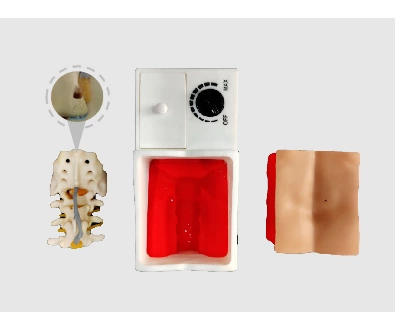
The Posterior Lumbar Dual-Channel Simulation Model is a complete surgical training model for Unilateral Biportal Endoscopy / Ventral Biportal Endoscopy (UBE/VBE) lumbar fusion.
It helps learners understand the anatomical morphology and structure of the lumbar region, enabling them to quickly familiarize themselves with minimally invasive UBE/VBE surgical workflows and instrument utilization. The model provides a realistic visual and surgical experience, allowing doctors to learn faster and better, and enabling more learners to rapidly master UBE surgical skills.
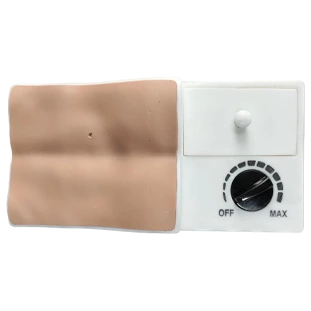
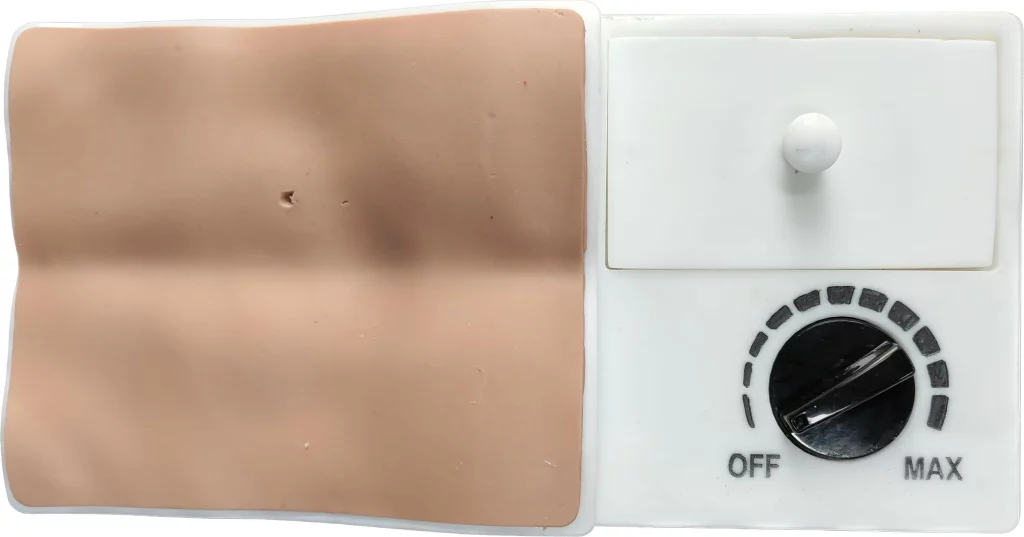
The Posterior Lumbar Dual-Channel Simulation Model. It simulates the morphology of real skin and possesses the curves of a realistic human spine
With a thickness of approximately 2 mm and a Shore hardness of A10±2, the touch is close to normal human skin, possessing elasticity and tension. The surgical operations are highly realistic, allowing for procedures such as skin disinfection, surface marking, puncture, cutting, suturing, and the establishment of surgical channels. The primary muscle material consists of a unique platinum silicone formulation featuring flexibility, elasticity, and tensile strength, which provides better instrument grip and a more realistic touch for puncturing, cutting, and establishing working channels.
The vertebral bodies are made of a unique biomimetic bone density material with a density similar to human bone.
It contains cortical bone and cancellous bone structures of different densities, allowing for surgical operations such as grinding, drilling, osteotomy, screw placement, plate placement, and fixation. When drilling, it produces a realistic hollowing-out effect and visible bone powder. The vertebral bodies do not crack easily, and the material does not easily adhere to cutting tools. The skeleton supports X-ray/CT imaging, providing clear image results where the vertebral bodies are distinctly identifiable and highly similar to real human structures. Under a CT scan, the cortical bone and cancellous bone are clearly distinguishable, showing significant differences in CT values.
The skin and muscles are consumable parts, which are reusable and easy to replace.
Key Training Applications:
- Pedicle Screw Insertion: Mastering entry points, trajectories, and tactile feedback of cortical vs. cancellous bone.
- Posterior Decompression/Laminectomy: Practicing delicate bone removal near vital structures.
- Lumbar Anatomy Mastery: Hands-on identification of spinous processes, laminae, facets, and neural pathways.
- Objective Skill Assessment: Standardized testing and competency benchmarking.
- Device Validation: Showcasing how implants and instruments perform under realistic anatomical resistance.
Simulation Advantages Over Traditional Training Methods
Training in orthopedics and spine surgery has traditionally relied on cadaver workshops, animal labs, or passive observation—all of which face challenges like high costs, biohazard regulations, and inconsistent pathology.
The Posterior Lumbar Dual-Channel Simulation Model offers three undeniable advantages:
| Advantage | Benefit |
| Reusability | Modules can be reset instantly, enabling standardized, scalable, and affordable education. |
| Safety | Novices can practice high-difficulty maneuvers endlessly without risk to human or animal life. |
| Efficiency | Instructors can provide real-time corrections on a repeatable platform, drastically increasing effective practice time. |