
Are low-cost USB microscopes really what you expect? Many customers ask themselves, “Is a $50 ‘microscope’ really a legitimate scientific device, or simply an inexpensive camera with a magnifying lens stuck on top?”
Is a $50 Microscope Really a Microscope? From a technical perspective, a $50 microscope is simply a high-magnification digital camera system designed for macro-photography. Although it does not have an elaborate system of lenses and objectives as does a traditional microscope, it does have the capability for 50x to 1000x magnification. This means that it does have microscope capability, as it has a short enough focal length to see objects that cannot be seen with the naked eye. However, it does not have a microscope capability for cell biology. l
- Is it a webcam? Structurally, yes—it uses the same CMOS sensor.
- Is it a microscope? Functionally, yes—it works for surface inspection, but not for biological cell studies.
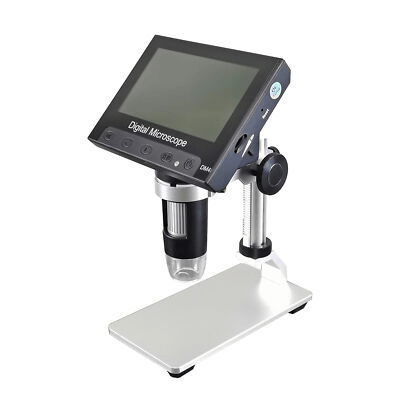
What Is a USB Microscope?
A USB microscope is also known as a digital microscope. Fundamentally speaking, the device is just like any other digital camera, but without the eyepiece. It does not have the expensive prism and eyepiece system like other optical microscopes but instead uses a CMOS camera to take pictures.
It is like having an eye that can look at things very closely, and the monitor or display device is like the retina of the eye.
USB Microscope vs Optical Microscope vs Webcam
And that’s where the greatest debate comes in: does a “USB microscope” even qualify as a microscope?
The truth is, most USB microscopes are more akin to a USB camera with a macro lens attached. Most $50 USB microscopes use the standard 2-megapixel CMOS camera sensor, the same kind found in webcams. The difference, it would seem, is not in the “brain,” but in the “vision”:
- Standard webcam: designed for focus ranges from ~50 cm to infinity
- USB microscope: designed to focus at extremely short distances (0 mm to ~50 mm)
By placing the lens close to the sensor and the object, these devices are able to obtain high magnification. The magnification looks quite high when viewed on a large screen, such as a 32-inch 4K monitor. However, the resolution does not improve.
These devices may not offer the formality of professional-grade optical devices, but they offer great convenience.
| Feature | Standard Webcam | $50 USB Microscope | $200+ Compound Microscope |
| Primary Use | Zoom calls / streaming | Coins, PCBs, insects | Bacteria, blood cells |
| Light Source | None (ambient) | Built-in LED ring | Substage transmitted light |
| Focus Range | 50 cm – ∞ | 0 mm – 50 mm | Fixed (fine adjustment) |
| Portability | High | Very high | Low (heavy/bulky) |
| “Cell” Test | Not visible | Possibly plant cell walls | Visible nuclei and bacteria |
What You Can See with a USB Microscope
While it is not a “true” scientific instrument, it is very useful in the following situations:
- Coin and stamp collecting: check minting errors, surface wear, etc.
- Electronics repair: check solder joints, micro-cracks in PCB traces, etc.
- Trichome inspection: commonly used by professional growers to check the maturity of plants
- Children’s education: check the wings of a bee, the blades of grass, RGB pixels on a phone screen, etc.

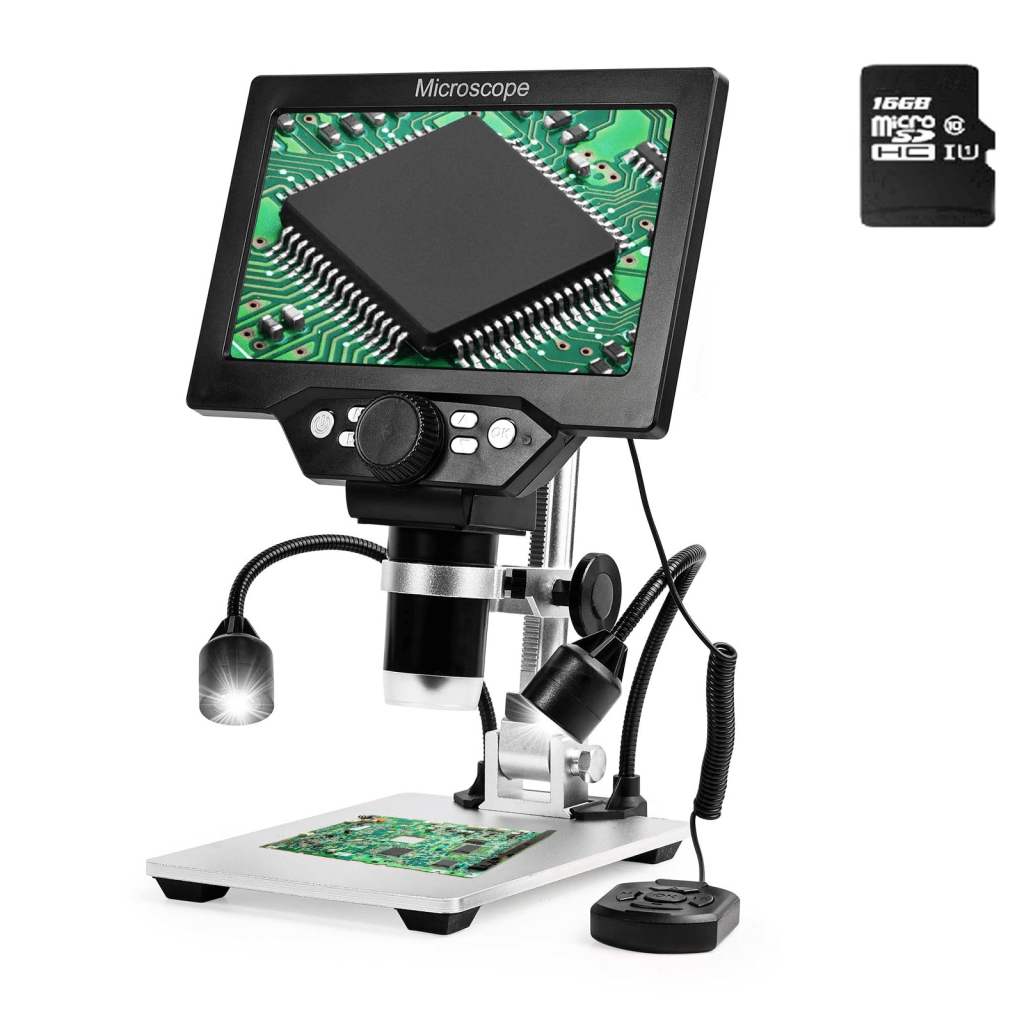
What You Cannot See with a USB Microscope
Do not be fooled by the “1000x” claims on the box! It’s not effective in the following areas:
- Medical Diagnostics: Never use it to examine moles or wounds. The colors are not accurate and may mislead
- Microbiology: You won’t be able to see the bacteria or moving microorganisms. To see these, you need a professional optical microscope with a condenser and at least a 40x objective lens ($150+).
Buying Tips
When you are purchasing, you may see devices that are described as having 5MP or 12MP, but they may be priced at just $50. These are not accurate, as the software may be enlarging the 2MP image and guessing the additional pixels, hence the blurry image.
It would be best to look at the camera’s optical resolution, as the product may be clearly described as 1080p or 2MP.
FAQ
Q: Can a USB microscope really achieve 1000× magnification?
A: Physically, it’s unlikely. This is usually “effective magnification” based on screen size. In practice, image quality drops significantly beyond ~200× optical magnification.
Q: Can it be used to observe bacteria?
A: No. Observing bacteria requires an optical microscope with a condenser and high-magnification objective lenses. Budget digital microscopes do not provide sufficient resolution.