

There is no need for complex thoughts on magnification or stopping every time to calculate manually. You can achieve the desired accuracy by following this easy trick; just jot it down for easy reference:
- For standard microscopes (no camera or monitor):
Eyepiece × Objective = Total Magnification - For digital microscopes (with a camera and monitor):
Objective × Adapter × Monitor Ratio = Total On-Screen Magnification
Here’s one final tip that will help you save even more time: place a strip of tape on your microscope with its critical numbers written down—eyepiece lens number, objective lenses most frequently used, and adapter, if it is used—and attach this strip right to the body of your microscope.
That’s all! There’s no theory involved—just an easy method of calculating your magnification every single time you use your microscope.
First: Find the 2 (or 3) Numbers You Need (5-Second Check)
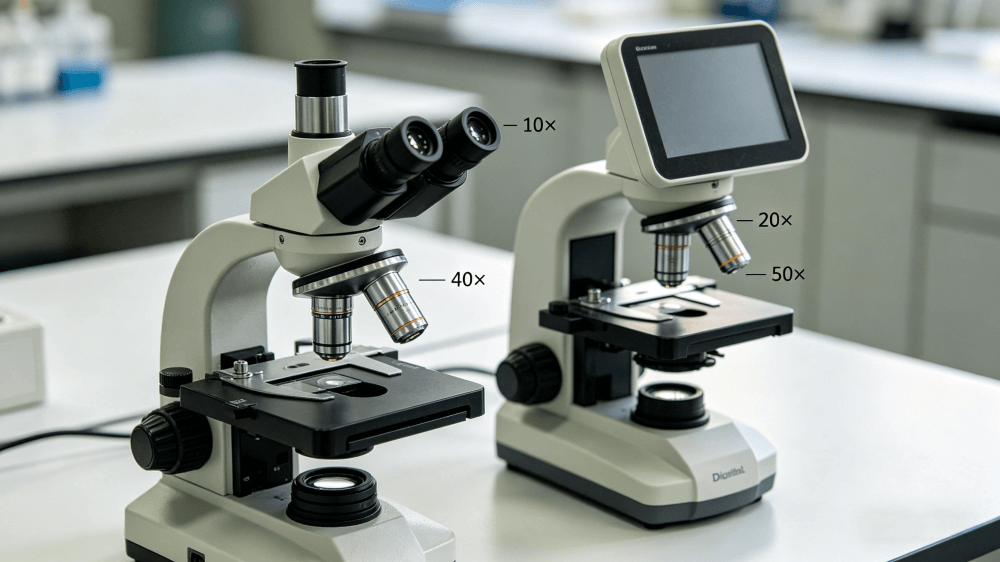
You don’t need to know parts names—just where to find the numbers (all microscopes have them, no exceptions). Here’s exactly where to look:
For Standard (Non-Digital) Microscopes (Most Common)
tive Number: This section requires a different approach. Turn the rotating lens turret until the objective lens you want to use aligns with the stage. Label each objective lens with a number and an “x” (4x, 10x, 40x, or 100x).
For Digital Microscopes (With Camera + Monitor)
Also add another number (really easy to get):
- Video Adapter Magnification Number: Check the connector that joins the microscope and camera. This should be something like 0.5x, 1x, or 0.45x—add this as well.
Trick for Numbers Not Visible: In case numbers aren’t visible due to wear and tear, point a light from your mobile phone at the lens/connector. Manufacturers usually engrave them on metal.
Calculate Total Magnification (10 Seconds, No Calculator Needed)
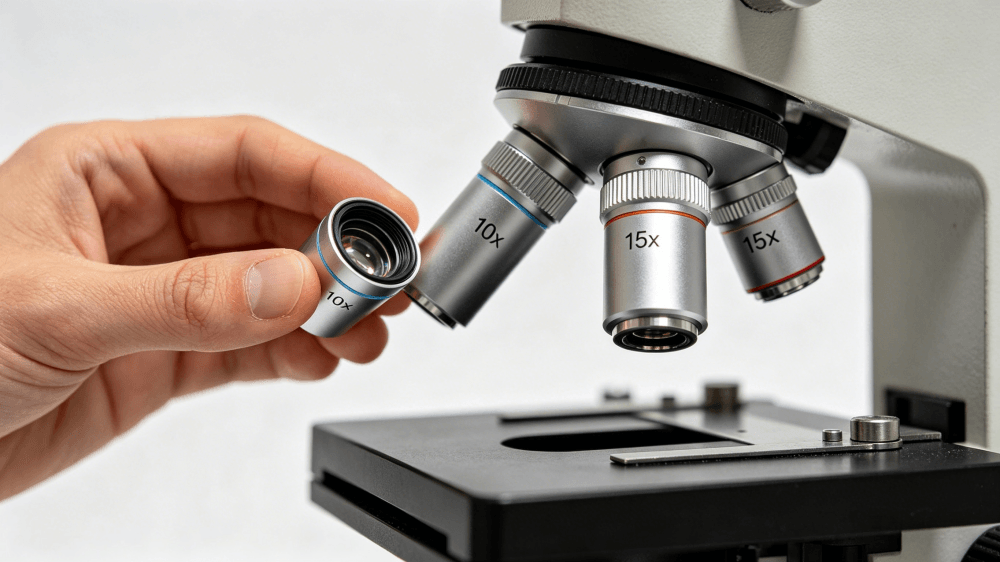
No complex formulas—just simple multiplication. Use these exact steps:
Standard Microscopes (Step-by-Step)
- Take your eyepiece number (e.g., 10x) and objective number (e.g., 40x).
- Multiply them: 10 × 40 = 400. That’s your total magnification (400x).
Real-World Examples (copy these if your numbers match):
- 10x eyepiece + 4x objective = 40x (good for quick scans)
- 10x eyepiece + 10x objective = 100x (everyday use)
- 10x eyepiece + 40x objective = 400x (detailed checks)
- 10x eyepiece + 100x objective = 1000x (only use if you have immersion oil—see Step 4)
Digital Microscopes (Step-by-Step)
Add one extra multiplication step (monitor ratio)—we’ll make this easy (no unit conversions you’ll forget):
- Calculate standard magnification first (eyepiece × objective): 10x × 40x = 400x.
- Multiply by your adapter number (e.g., 0.5x): 400 × 0.5 = 200x.
- Find monitor ratio (use this cheat sheet—no math!):
- Multiply by monitor ratio: 200 × 38.1 = 762 × (your total on-screen magnification).
Pro Hack: Save the monitor ratio cheat sheet to your phone—you’ll never have to calculate it again.
Microscope Magnification Cheat Sheet
| Objective Lens | Color Code | Optical Total (10x Eyepiece) | Digital Total (24″ Screen, 0.5x Adapter) | Best For… |
| Scanning | Red | 40x | 152x | Circuit boards, insects |
| Low Power | Yellow | 100x | 381x | Blood smears, pond water |
| High Power | Blue | 400x | 1,524x | Cell nuclei, chromosomes |
| Oil Immersion | White | 1000x | 3,810x | Bacteria (Must use oil!) |
4 common mistakes (Fix Them Now)

These are the errors people actually make—avoid them to get accurate results on the first try:
Mistake 1: Using 100x lens without oil
If your objective is 100x, you must put a drop of immersion oil on the slide. No oil = blurry image, and your magnification number is useless.
Mistake 2: Forgetting the adapter on digital setups
Skipping the 0.5x adapter (super common!) will make your on-screen magnification double what it actually is—always include it.
Mistake 3: Mixing up objective lenses
If your image is blurry, check if you spun to 40x instead of 10x. The number on the turret is easy to mix up—double-check before calculating.
Mistake 4: Overcomplicating it
You don’t need to know “resolution” or “lens types”—just find the numbers and multiply. That’s it.