
When identifying minerals under a microscope, the most reliable method is not “guessing the name by color,” but using a polarizing microscope to combine color, relief, cleavage, and pleochroism under plane-polarized light with interference color, twinning, and extinction characteristics under crossed polars. Although there are thousands of minerals in nature, over 99% of Earth’s crustal rocks are composed of just a few dozen rock-forming minerals. Although quartz and feldspar, pyroxene and amphibole, etc., appear very similar in certain fields of view, they can be gradually distinguished through the combination of characteristics.
Simply put, the identification conclusion is “match the microscopic features to find your place”: clean and untextured is quartz, zebra-striped or dirty-looking surface is feldspar, right-angle cracks is pyroxene, color-changing when rotating the lens with oblique cracks is amphibole, like multi-layered paper and color-changing is mica, and heavy black borders with many cracks is olivine—mastering this set of visual features allows you to precisely lock in the identity of the mineral under the lens.
What are the categories of common minerals? First, distinguish between “mineral classification” and “microscopic identification classification”
From the perspective of mineral composition and structure, common minerals include silicates, carbonates, oxides, sulfides, and phosphates. Quartz, feldspar, pyroxene, amphibole, and olivine all belong to silicates, but their crystal structures differ; therefore, their cleavage, morphology, and optical performance under the microscope also differ.
- Opaque grains: Appear black under both plane-polarized light and crossed polars.
- Transparent, isotropic grains: Transmit light under plane-polarized light, and remain continuously dark when rotating the microscope stage under crossed polars, such as most garnets with normal optical performance.
- Transparent, anisotropic grains: Usually show light-dark changes and interference colors with rotation under crossed polars; most common rock-forming minerals belong to this group.
| Mineral Category | Common Representatives | Microscopic Identification Focus |
| Framework Silicates | Quartz, Plagioclase, K-Feldspar | Mostly colorless, low relief, low interference colors; compare twinning, cleavage, and alteration. |
| Single-Chain Silicates | Orthopyroxene, Clinopyroxene | Prismatic habit, near right-angle cleavage; combine interference colors and extinction style. |
| Double-Chain Silicates | Amphibole Group (e.g., Hornblende) | Two non-right-angle cleavages, common prismatic habit, distinct pleochroism. |
| Island Silicates | Olivine, Garnet | Often high relief, but XPL behaviors vary dramatically. |
| Sheet Silicates | Biotite, Muscovite, Chlorite | Flaky habit, one distinct cleavage; compare inherent color, pleochroism, and interference color. |
| Carbonates | Calcite, Dolomite | Rhombohedral cleavage, high-order interference colors; stain tests if needed. |
| Oxides | Magnetite, Hematite, Ilmenite | Many common members are opaque in transmitted light. |
| Sulfides | Pyrite, Chalcopyrite | Generally opaque in transmitted light; require reflected light for study. |
| Phosphates | Apatite | Fine prismatic or hexagonal cross-sections, distinct relief, low interference colors. |
How to identify different minerals under a microscope?(What to Look For)
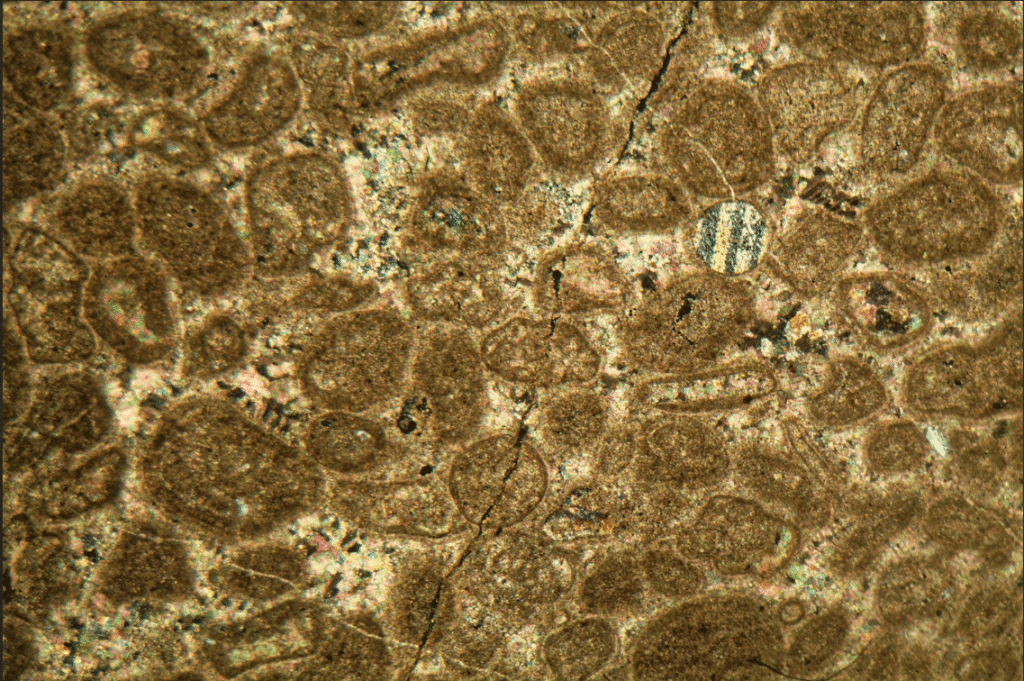
Mineral identification relies on a multi-dimensional cross-verification strategy: “PPL establishes the baseline, while XPL defines the character.”
Mineral identification relies on a multi-dimensional cross-verification strategy: “PPL establishes the baseline, while XPL defines the character.”
1. Plane-Polarized Light (PPL)
Under a single polarizer, PPL is mainly used to observe transmitted color, crystal habit, cleavage, relief, and pleochroism.
PPL Color (Thin Section vs. Hand Specimen): Always evaluate the color of the grain in thin section rather than its hand-specimen appearance. For instance, olivine is often bright olive-green in hand specimen but nearly colorless in thin section, while biotite ranges from light to dark brown rather than solid black.
Relief (Refractive Index Contrast): Relief reflects the refractive index difference between the mineral and its surrounding medium (not its physical height). A greater difference makes grain boundaries and surface flaws sharper and darker.
- Low relief: Quartz, feldspar (plain, fuzzy boundaries).
- High relief: Olivine, garnet (thick dark borders, strong 3D appearance).
Cleavage (Parallel, Repeated Fracture Lines): Cleavage represents a mineral’s tendency to split along specific crystallographic planes, appearing as regular parallel lines (random fractures are distinct).
- Mica: One highly distinct basal cleavage.
- Pyroxene: Two cleavages intersecting near a right angle (≈90°).
- Amphibole: Two cleavages intersecting at ≈56° and ≈124°Quartz / Olivine: Quartz lacks cleavage; olivine lacks clear cleavage but often displays irregular fractures.
- (Note: Cleavage angles vary by slice orientation; always check multiple grains for standard cross-sections).
Pleochroism (Color Variation Upon Rotation): Rotating the microscope stage under PPL may reveal changes in color intensity or hue for certain minerals. Biotite and many amphiboles show strong pleochroism, whereas quartz and feldspar do not. (Note: Must be judged in PPL only, never confused with XPL colors).
2. Crossed Polars (XPL)
With polarizer and analyzer crossed at 90 degrees, XPL is used to observe interference colors, twinning, extinction, and isotropy/anisotropy.
Interference Colors (Birefringence Brilliance): The striking colors produced by double refraction. They depend on birefringence, thin-section thickness, and grain orientation—meaning they aren’t a fixed “ID card” for any single mineral.
- Quartz & Feldspar: Primarily low-order grays and whites.
- Olivine & Muscovite: Often brighter, higher-order interference colors.
- Calcite: Extremely high birefringence, showing pale pastel high-order colors.
- Chlorite: May display abnormal blue or brown interference colors.
Twinning and Extinction (Internal Structure & Darkening Behavior):
- Twinning: Regular intergrowth of crystal orientations, appearing as parallel stripes, cross-hatches, or alternating light/dark regions (e.g., plagioclase polysynthetic twinning, microcline grid twinning).
- Extinction: The phenomenon where a mineral turns dark as it rotates to specific angles. Extinction angles relative to cleavage help identify pyroxenes, while progressive darkening across a single grain indicates undulatory extinction (common in quartz).
Differences in Microscopic Appearance Between Different Minerals
| Mineral Category | Core Microscopic Features | Identification Conclusion |
| Quartz | Colorless, no cleavage, no twinning, 1st-order white/gray | Clean and unmarked = Quartz |
| Plagioclase / K-Feldspar | Cloudy surface, parallel striations or grid patterns | Zebra-striped or cloudy surface = Feldspar |
| Pyroxene | Moderate relief, square cross-section, right-angle cleavage | Right-angle cleavage cracks = Pyroxene |
| Amphibole | Strong pleochroism, diamond/rhombic section, oblique cleavage | Color-changing with oblique cleavage = Amphibole |
| Mica | Book-page sheet habit, extremely strong pleochroism | Page-like habit with color change = Mica |
| Olivine | Very high relief, no cleavage, full of fractures | High relief with thick fractures = Olivine |