
Under a polarizing microscope, an isotropic mineral appears black (extinction) under cross-polarized light (XPL) and remains black throughout a full rotation of the microscope stage. This is the main characteristic for identifying isotropic minerals.
| Microscope State | Appearance of Isotropic Mineral |
| Plane-Polarized Light (PPL) | Transparent or colored, not necessarily black |
| Cross-Polarized Light (XPL) | Black / Extinction |
| Rotating Stage | Remains black throughout, no interference colors appear |
| Birefringence | Zero |
Under Cross-Polarized Light (XPL / Crossed Nicols) — Total Darkness
The definitive diagnostic feature of an isotropic mineral is that it appears completely black (isotropic extinction) in all directions when you rotate the microscope stage 360 degrees.
Isotropic minerals (e.g., cubic minerals such as garnet, fluorite, spinel, halite, and amorphous substances like volcanic glass) have a uniform crystal structure, and light travels at the same speed in all directions. They have only one refractive index ($n$), meaning they do not split light into two rays (no birefringence), nor do they rotate the plane of polarization.
Therefore, the light passing through the mineral cannot pass through the vertical analyzer filter above the stage, resulting in the mineral permanently appearing dark.
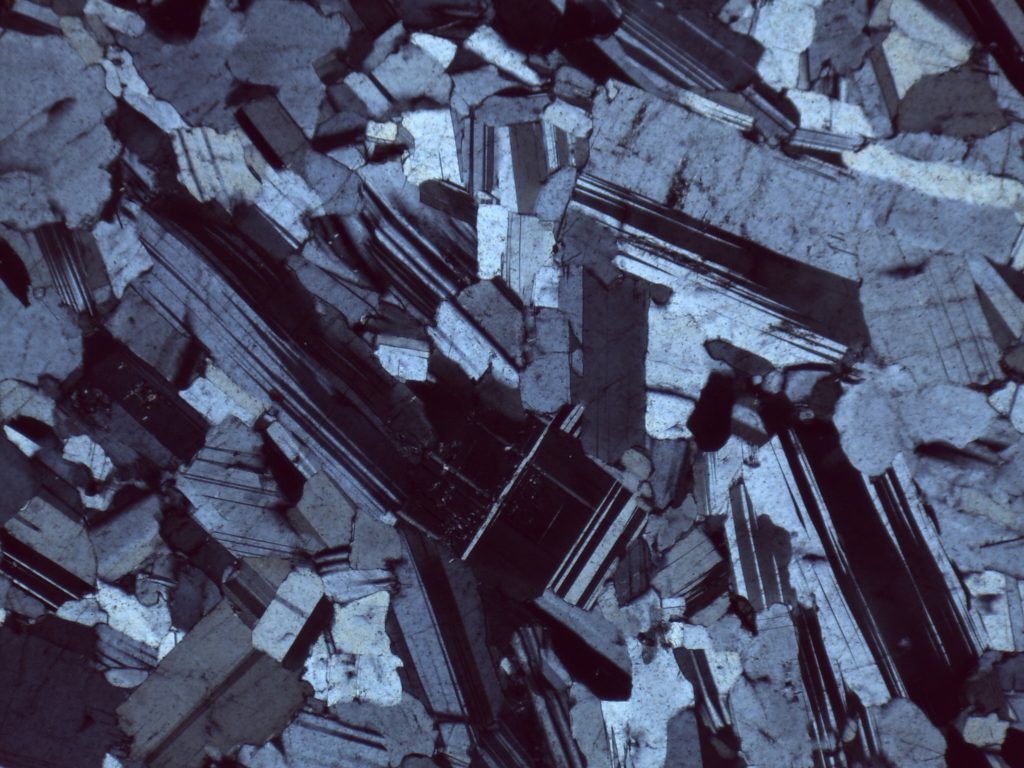
before 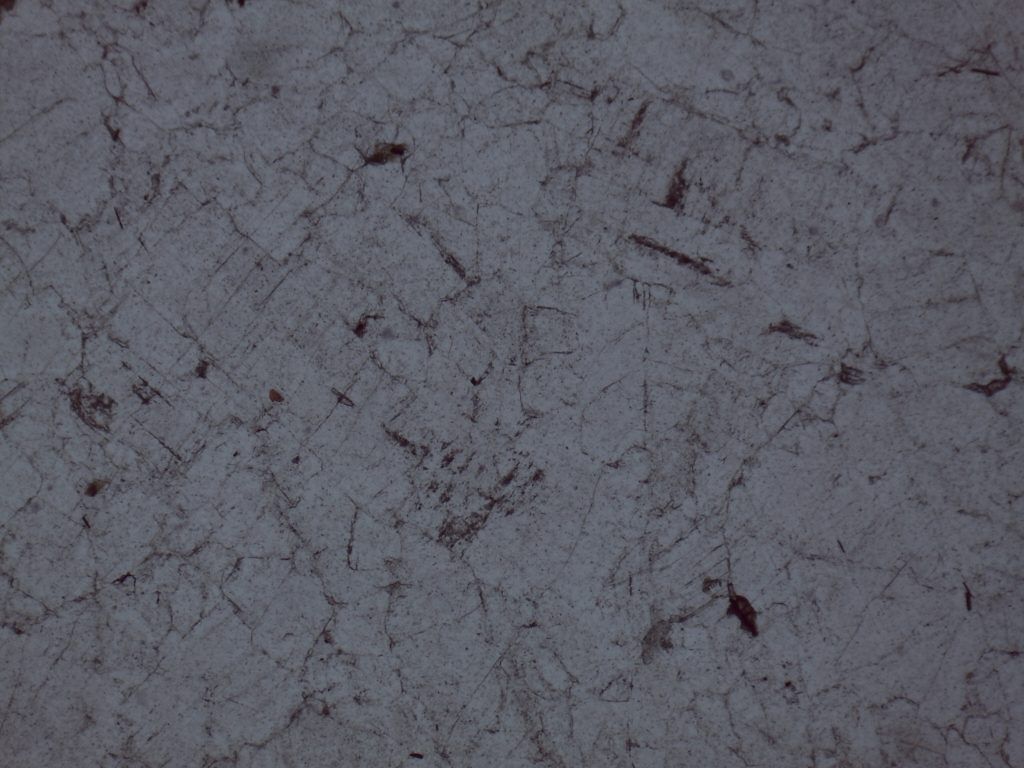
after
Albite and Carlsbad twinning in plagioclase. 100x total magnification.source:VIVA’s Pressbooks
Under Plane-Polarized Light (PPL) — Normal Appearance
Under ordinary plane-polarized light, isotropic minerals look like ordinary transparent or translucent mineral grains. Their appearance depends on their specific chemical composition:
Surface Relief: Many isotropic minerals (such as garnet) have high surface relief, with an uneven, rough surface and clear boundaries. Other minerals, such as fluorite, have lower surface relief.
Color and Pleochroism: They may be colorless or show natural colors (for example, some garnets are pinkish-brown to red), but they do not exhibit pleochroism (changing color as the stage rotates), because their optical properties are the same in every direction.
Core Principle: Why Can It “Disappear” (Appear Black)?
Simply put, isotropic minerals have the same refractive index in all directions. When light passes through them, it is neither split nor changes its polarization direction. When the upper analyzer is lowered, this part of the light is ruthlessly “intercepted”, and the field of view naturally becomes pitch black. This characteristic of “remaining black no matter what” has become the strongest code for geologists to identify them.
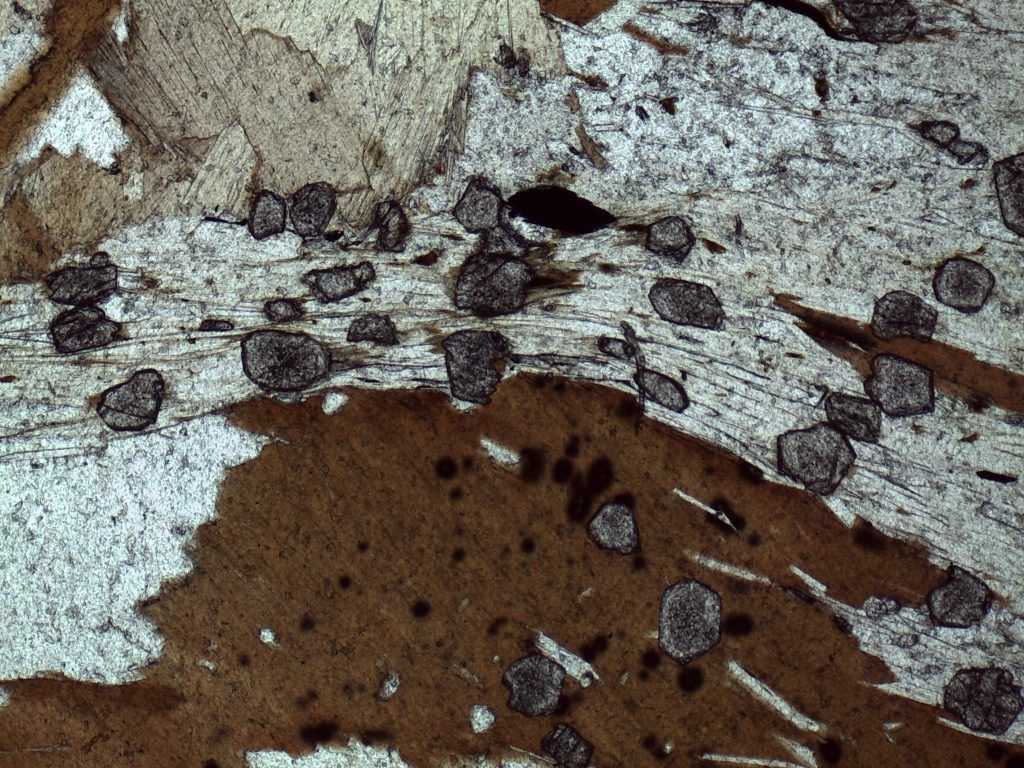
before 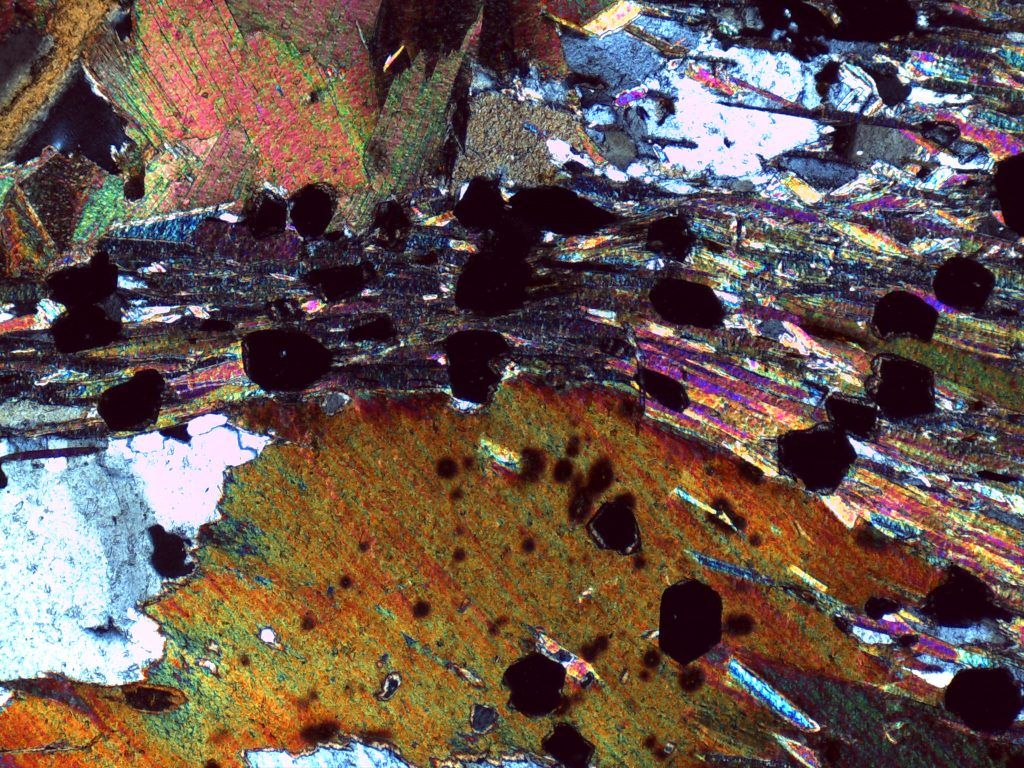
after
Schist from Galax, VA, at 40x total magnification. PPL=plane polarized light; XPL = cross polarized light.source:VIVA’s Pressbooks
Common Isotropic Materials in Thin Section
- Garnet: High relief, usually euhedral (rounded 6- or 8-sided shape), completely black in XPL.
- Fluorite: Low relief, sometimes colored or banded, isotropic in XPL.
- Spinel: High relief, usually dark green or brown, isotropic in XPL.
- Volcanic Glass: Amorphous (non-crystalline), completely isotropic, dark in XPL.
Precautions: How to Distinguish Between Isotropic Transparent Minerals and Opaque Minerals
Beginners often confuse isotropic minerals with opaque minerals because they both look black under cross-polarized light. In fact, the difference between the two is very obvious (do not confuse isotropic minerals with opaque minerals):
Isotropic Transparent Minerals: Only appear black under cross-polarized light (XPL); but light can pass through under plane-polarized light (PPL), and the outline, color, and relief of the grains can be seen.
Opaque Minerals (such as metallic minerals): Completely opaque under both plane-polarized and cross-polarized light, always remaining pitch black.